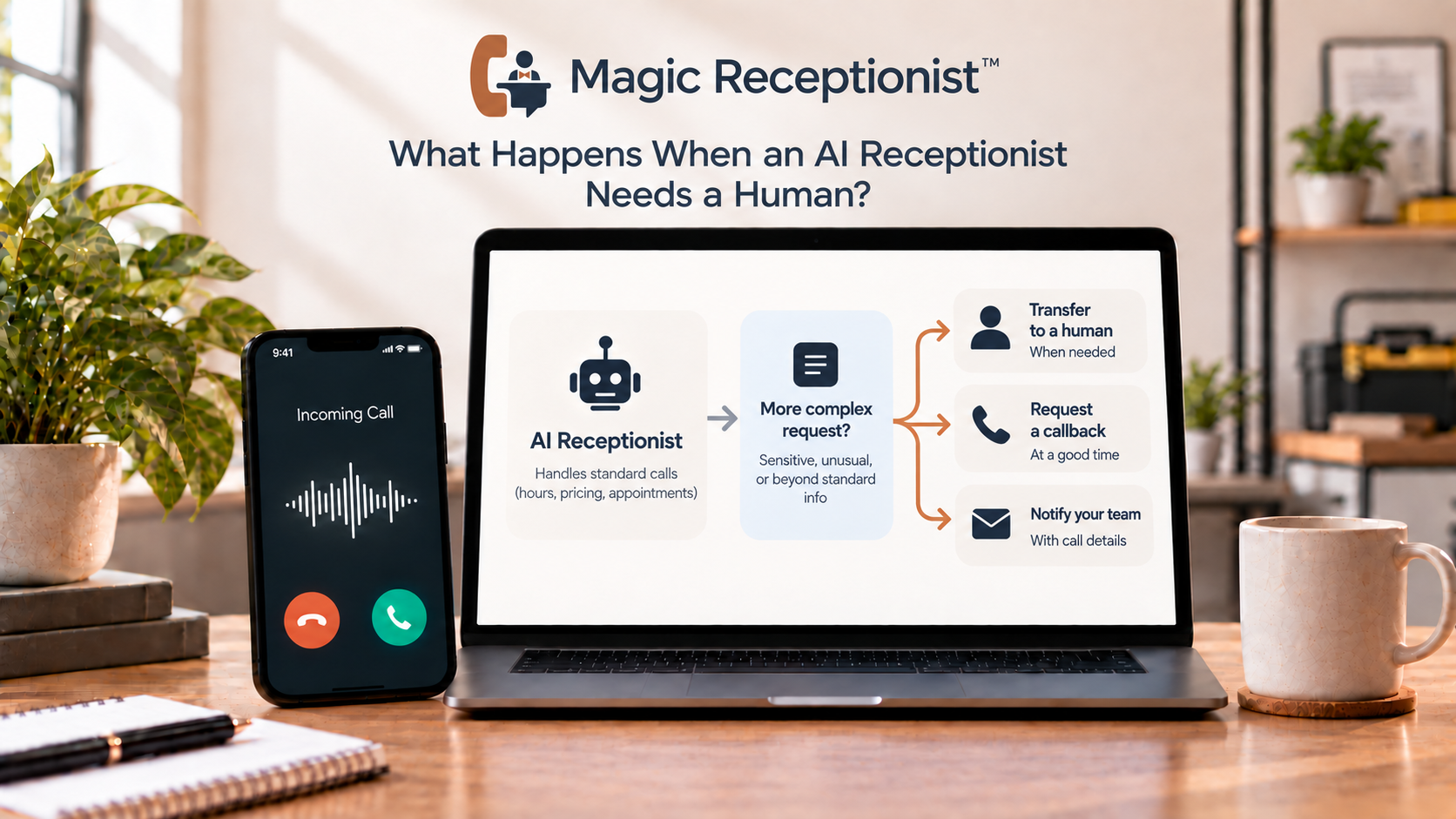
When an AI receptionist needs a human, the right behavior is not to improvise a better answer. It is to follow the handoff or escalation path the business configured.
That path might be a live transfer, a callback request, a message for a specific person, or another defined follow-up. The correct choice depends on the business, the call type, staff availability, and the workflow that is actually enabled.
A good AI receptionist is not useful because it tries to handle everything. It is useful because routine calls can move forward consistently while judgment, sensitive conversations, and exceptions stay with the right people.
What should happen when the AI does not know the answer?
It should not guess.
If the answer is not in the approved business information or the request falls outside the configured workflow, the receptionist should acknowledge the limit and move the caller toward the next approved step.
For one business, that may mean taking a message. For another, it may mean collecting a callback request. A business with a configured transfer path may send certain calls to a person when that person is available.
The key is that the fallback is designed before the call happens.
Can an AI receptionist transfer a caller to a human?
Yes, when live transfer is part of the supported and configured setup.
That does not mean every Magic Receptionist deployment automatically has the same transfer behavior. A business may use callback, follow-up, or another handoff instead.
If live transfer matters, define which calls should transfer, who receives them, what hours that person or group is available, and what happens if nobody answers.
A transfer rule without a backup path simply moves the missed-call problem somewhere else.
When should a person stay involved?
Human staff are especially important when the call requires judgment rather than repeatable intake.
Common examples include complaints, emotionally sensitive conversations, unusual exceptions, professional advice, high-stakes decisions, negotiation, account-specific discretion, and questions the business has not approved the AI to answer.
Regulated industries may have additional boundaries. A medical receptionist should not diagnose. A legal intake workflow should not give legal advice. A service-business receptionist should not invent a repair diagnosis or binding price when the business has not provided one.
The AI can still help by collecting the caller's stated context and leaving the human a cleaner starting point.
What if the caller simply asks for a person?
The workflow should define that case too.
Some businesses may want a configured transfer during staffed hours. Others may prefer the receptionist to collect the caller's name, number, reason for calling, and requested person so the team can return the call.
The receptionist should not pretend that a transfer is happening when the setup only supports a callback.
Clear language is better for the caller and easier for the team to operate.
Build the escalation rule around the reason for the call
Not every request for a human needs the same treatment.
A new sales inquiry, a safety-sensitive service problem, a billing complaint, and a caller asking for a specific employee may all need different next steps.
For each important call type, define:
- What the AI may answer or collect.
- What condition means the AI should stop trying to resolve the request.
- Whether the next step is transfer, callback, message, or another action.
- Who owns the human follow-up.
- What happens after hours or when the intended person is unavailable.
That turns "talk to a human" into an operating rule instead of an exception nobody planned for.
What should the AI collect before handing off?
Only collect information that helps the next person act.
For a typical service business, useful context may include the caller's name, callback number, reason for calling, service location when relevant, urgency as described by the caller, and the requested next step.
The exact fields should match the business workflow.
Do not make a frustrated or sensitive caller repeat a long intake merely because the form has many fields. The handoff should reduce friction, not create it.
What happens after hours?
After-hours coverage makes the fallback design even more important because a live staff member may not be available.
The receptionist can still answer the configured call path, collect approved context, and leave the team a clear follow-up record. If the business has an on-call or escalation process, that process needs to be explicitly configured and tested.
Do not describe ordinary AI call coverage as an emergency service. Safety-critical or emergency situations need the appropriate human or emergency path defined by the business and applicable rules.
Test the human handoff before launch
Do not test only routine calls.
Run scenarios where the caller asks an unknown question, requests a person, becomes upset, calls after hours, gives incomplete information, or raises a situation that the AI should not decide.
For each test, verify:
- The AI recognized the boundary.
- It did not invent an answer.
- It collected only useful approved context.
- The correct transfer, callback, or follow-up path was triggered.
- The team knew who owned the next action.
A fallback is part of the core call experience, not a rare edge case.
How Magic Receptionist handles the boundary
Magic Receptionist is configured around the call paths, questions, business facts, and next steps a business approves.
When a call needs more help, the business defines the follow-up or escalation path during setup. Live transfer can be used where that path is supported and configured. Otherwise, the receptionist can capture the context needed for a callback or another follow-up step.
The business remains responsible for the human decisions it has kept outside the receptionist's role.
Bottom line
An AI receptionist should know when to stop.
Design the human path before launch. Decide which situations require judgment, what the AI should collect, whether transfer is actually configured, who owns callbacks, and what happens when staff are unavailable.
That gives routine calls the benefits of consistent intake without asking automation to replace the parts of customer service that still need a person.