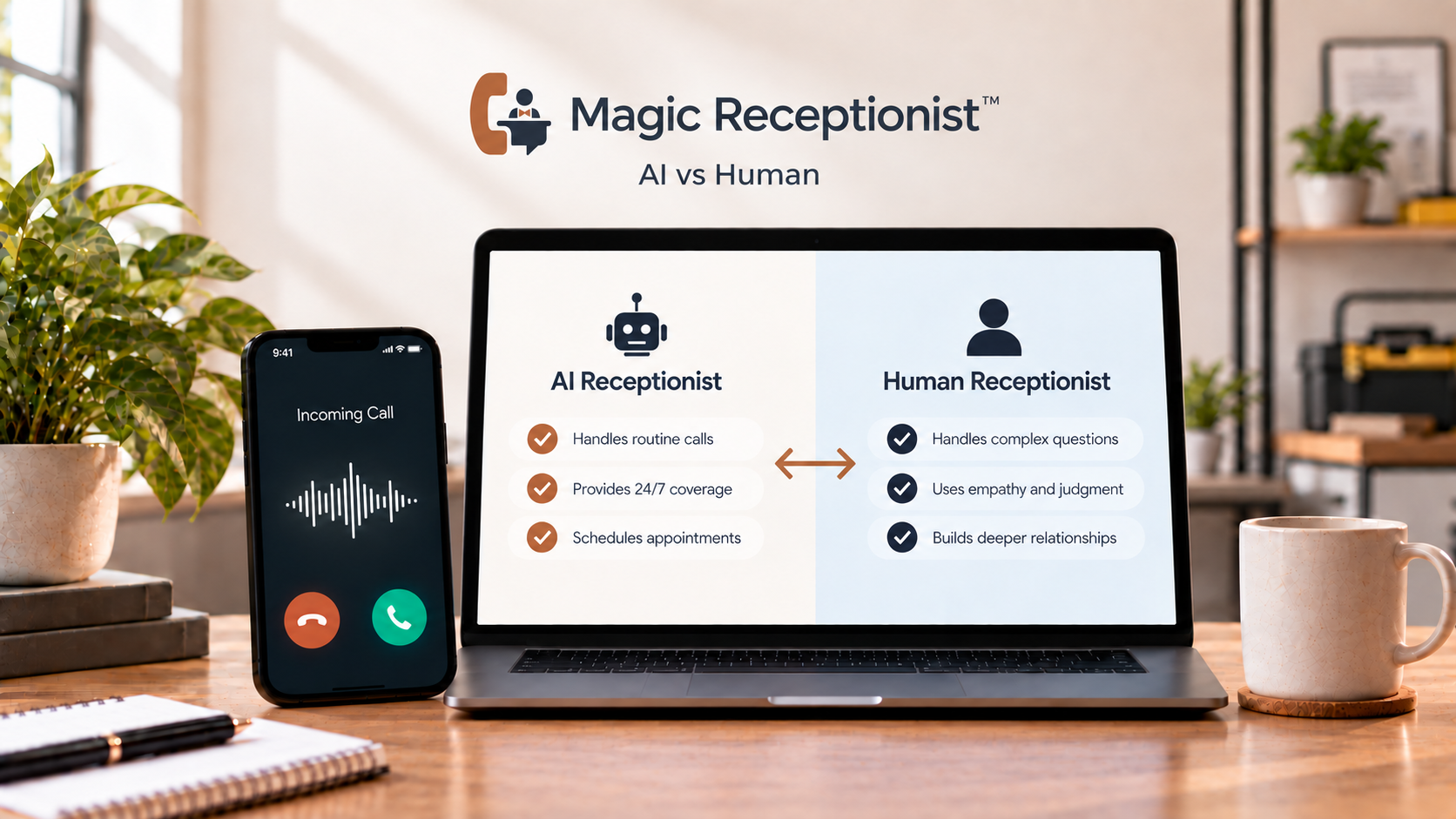
Where each option fits best
AI works well for repeatable coverage and intake. People are stronger when a call needs judgment, context, sensitivity, or in-person front-desk work. Many service businesses use both.
Coverage
Reliable for configured overflow and after-hours intake
Depends on staffing, shifts, breaks, and availability
Consistency
Follows the same approved intake flow on repeatable calls
Can adapt the flow naturally as context changes
Judgment
Best when the decision rules and escalation paths are defined
Stronger for nuance, exceptions, sensitive conversations, and discretion
Physical front desk
Handles phone workflows, not in-person office work
Can greet visitors and handle on-site coordination
Best fit
Predictable first-line calls, coverage gaps, and structured intake
Relationship-heavy work, unusual situations, and decisions requiring context
Choosing between an AI receptionist and a human receptionist is not really a question of which one is universally better. They solve different parts of the front-desk problem well. For many service businesses, a practical setup is hybrid: automation handles predictable first-line intake and coverage gaps, while people handle judgment, exceptions, sensitive conversations, and relationship-heavy work.
The decision should start with the calls your business actually receives and the experience you want customers to have.
What an AI receptionist is good at
An AI receptionist works well when the work can be defined clearly. That includes answering inbound calls, asking a consistent set of intake questions, collecting contact and service information, identifying what the caller needs, and helping the request reach the right next step.
For a service business, that may include routine estimate requests, service-location capture, appointment requests, after-hours messages, or overflow coverage while staff are already helping other customers.
The main advantage is consistency. The same approved questions can be asked on every relevant call, including during evenings, weekends, and busy periods. When the intake is configured well, the team can receive a structured callback record instead of relying only on whatever a caller chooses to leave in voicemail.
What a human receptionist is good at
People are better suited when the situation requires judgment, empathy, negotiation, improvisation, or awareness of what is happening inside the business right now.
A human receptionist can recognize unusual context, coordinate across changing priorities, calm an upset customer, and handle relationship-heavy interactions that benefit from someone who understands the business beyond a standard intake flow.
Humans also remain important for decisions involving professional judgment, sensitive customer situations, exceptions, complaints, pricing exceptions, job acceptance, or other cases where context matters more than consistency.
Availability: automation fills coverage gaps, people provide judgment
A business does not have to choose between "AI always" and "human always." A better question is: which calls need a person immediately, and which calls mainly need to be answered, understood, and routed correctly?
An AI receptionist can cover evenings, weekends, lunch periods, overflow, or other times when the team cannot reliably reach every ring. A human can remain the destination for high-value, sensitive, unusual, or escalated situations.
This is especially useful for service teams where the people who know the work are often away from the phone. Technicians, owners, estimators, dispatchers, and office staff may all have periods when answering every inbound call is unrealistic.
For more on the coverage problem itself, see AI Receptionist for Service Businesses.
Cost: compare the full operating model
Cost matters, but a useful comparison includes more than one monthly number.
For a human receptionist, consider compensation or vendor fees, schedule coverage, training, management, time off, and whether one person can cover the hours your business needs.
For an AI receptionist, consider the current subscription or usage structure, setup needs, integrations, and whether the system covers the call types and hours that matter to you.
The useful question is what it costs to deliver the level of coverage and customer experience your business actually needs. Magic Receptionist pricing varies by plan and setup. Check the current pricing page for the options that apply to your business.
Consistency versus flexibility
Automation is useful when consistency matters. A defined intake can ask for the same contact details, location information, service request, and preferred next step on every relevant call.
Humans are more adaptable. They can change direction when the caller's situation does not match the normal flow, notice subtle context, and make judgment calls that do not belong in a standard script.
That means consistency and flexibility do not have to compete. A business can automate the predictable first layer and bring in a person when the conversation needs human judgment.
Customer experience: the goal is progress
The important customer question is not whether the first voice is AI or human. It is whether the caller can make progress.
A poor AI experience that traps the caller in a rigid script is not useful. A human front desk that regularly misses calls or sends people to voicemail is not useful either.
A good intake experience should be clear, concise, and focused on what happens next. It should collect only information that helps the business respond and make it easy to reach a person when the situation calls for one.
When a hybrid model makes sense
A hybrid model is often a practical choice when a business wants better coverage without removing people from the process.
One example is:
- The AI receptionist answers the inbound call.
- It identifies why the person is calling and collects the basic information the team needs.
- Routine requests become structured callback or appointment-request records.
- When configured, urgent, unusual, or high-value situations follow a human escalation path.
- A human handles exceptions, sensitive conversations, final decisions, and relationship work.
This approach lets the business decide where automation helps and where human attention matters most. The exact handoff, notification, booking, or routing behavior depends on the workflow the business has configured.
Questions to ask before choosing
How many calls are going unanswered?
Start with the coverage problem. If calls are mainly being missed during jobs, lunch, evenings, weekends, or peak periods, an automated intake layer may solve the problem without changing the rest of the team.
Which calls genuinely require human judgment?
Write them down. Those calls should have a clear path to a person.
What information does the team need before following up?
If most inbound calls begin with the same core questions, that is a strong candidate for structured automation.
Does the business need in-person front-desk work?
If the receptionist also greets visitors, manages physical paperwork, handles on-site coordination, or performs operational work beyond the phone, an AI phone receptionist does not replace those responsibilities.
Bottom line
An AI receptionist works as a coverage and intake system, not as a blanket replacement for people. Human receptionists bring judgment, empathy, flexibility, relationship context, and awareness of what is happening inside the business.
For many service businesses, the useful answer is to automate predictable phone work and preserve human attention for the situations where a person adds the most value.