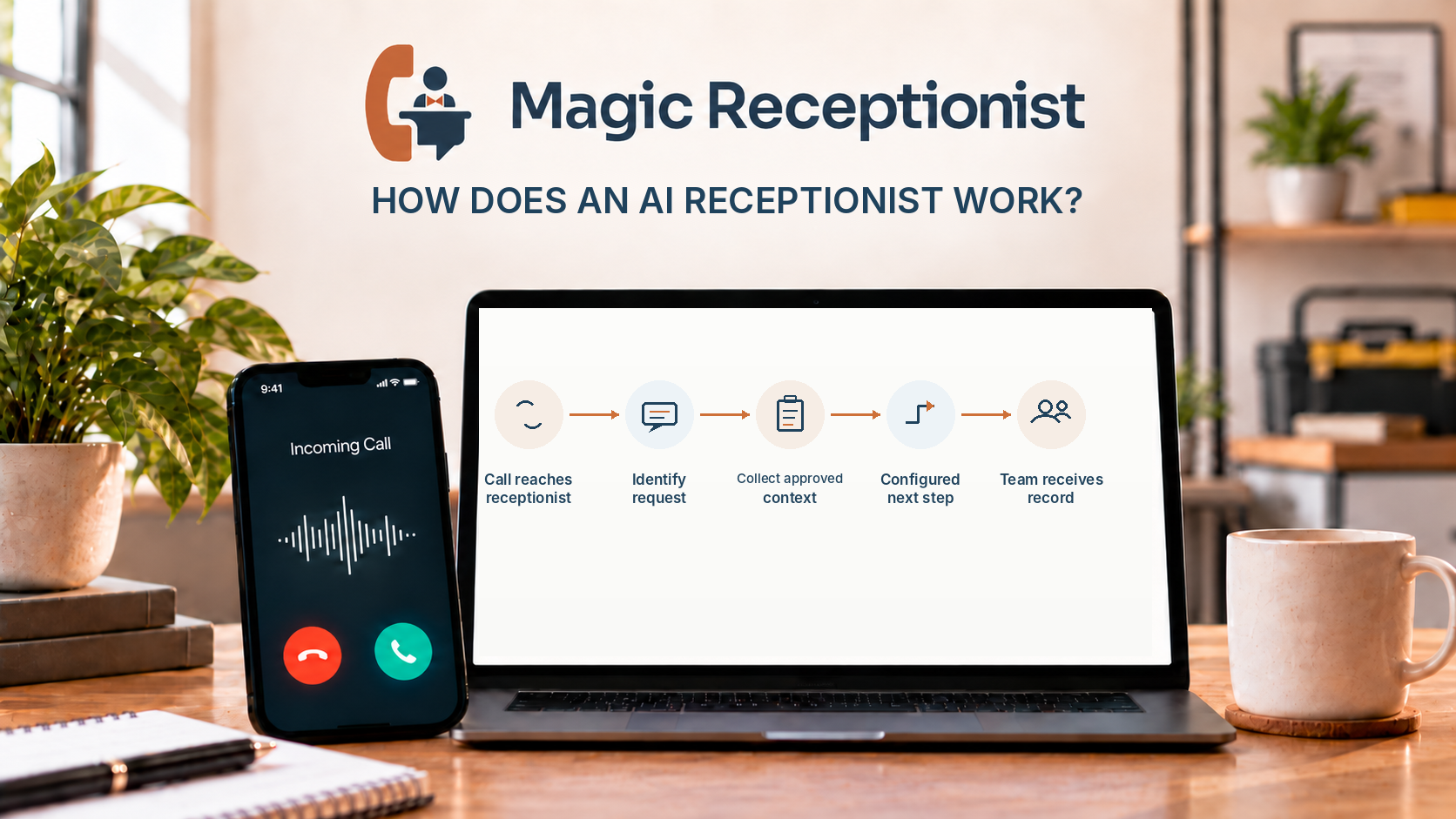
An AI receptionist works by combining a configured phone entry point with a conversational intake flow and a set of business rules for what should happen next.
The important part is the workflow, not the novelty of the voice. A reliable setup should answer the calls it is meant to handle, collect the information the business needs, follow approved routing or escalation rules, and produce a useful result for the team.
Magic Receptionist follows that same principle. It is designed around configured inbound call paths rather than assuming every business needs the same script or the same actions.
Step 1: the call reaches the configured receptionist
The process starts with the business's phone setup.
Depending on the deployment, calls may reach the receptionist through a configured business number, forwarding arrangement, or another approved phone-routing path. The exact carrier and number configuration matters, so setup should be verified for the specific business rather than described as one universal method.
Once the call reaches the receptionist, it can answer with the approved business greeting and begin the intake flow.
Step 2: the receptionist identifies why the person is calling
The receptionist needs a clear purpose for the conversation.
A service business might receive new-service inquiries, existing-customer questions, estimate requests, appointment requests, after-hours calls, wrong numbers, vendor calls, or situations that need a person.
The configured flow should identify the caller's reason without turning the conversation into a long interrogation. The goal is to understand enough to choose the right intake path.
Step 3: it collects the approved caller context
Next, the receptionist asks for the information the business has decided is useful.
That can include a name, callback number, service location, reason for the call, or other approved fields. The exact questions should depend on the business and the call type.
For example, a field-service company may need a location and a short description of the issue. Another business may only need contact information and the reason for the inquiry.
More questions are not automatically better. Every question should have a clear reason.
Step 4: it follows the configured next step
This is where AI receptionist systems can differ substantially.
A configured workflow may create a call record, notify the team, route or escalate a call, or support another connected action. Some setups may also support booking or integrations when those workflows have been configured and verified.
Those capabilities should be described conditionally. A receptionist should not tell a caller that an appointment is booked, a transfer is happening, or an integration has updated a system unless that action is actually available in the current setup.
When the requested action is outside the approved workflow, the safer path is to capture the context and follow the business's escalation or follow-up rules.
Step 5: the team receives the result
The call is only useful if the business can act on what happened.
Magic Receptionist supports call summaries or transcripts where enabled, plus configured notification and handoff behavior. The output should give the team enough context to understand who called, why they called, and what the next step is supposed to be.
A good call record is concise enough to scan but detailed enough to avoid making the caller repeat the entire conversation.
What happens when a call needs a person?
The business should decide this before launch.
Human escalation rules can cover callers who explicitly ask for a person, sensitive situations, complaints, high-risk or safety-related questions, unusual requests, and anything outside the receptionist's approved authority.
The exact route depends on the business's setup. The important thing is that the boundary is intentional. AI should not make professional, safety, or policy decisions merely because it can continue a conversation.
Can an AI receptionist book appointments?
It can support booking when the relevant scheduling workflow is configured and verified.
That is different from saying every AI receptionist installation automatically books appointments. Some businesses may want an appointment request captured for staff confirmation. Others may have a connected workflow that can complete a booking. The customer-facing conversation should match the actual configuration.
The same rule applies to transfers, CRM updates, text messages, email notifications, and other integrations.
How do you set up the call flow?
Start with the current process rather than an imaginary ideal process.
List the main call types your business already receives. For each one, write down:
- What should the receptionist learn from the caller?
- What can it safely handle without a person?
- What requires human judgment?
- What should the team receive after the call?
- What should happen when the caller does not fit the expected path?
Then build the simplest version that handles the common calls well.
Why test calls matter
A script can look correct on paper and still feel awkward in a real conversation.
Before going live, test routine inquiries, vague requests, interruptions, after-hours calls, wrong numbers, and situations that should escalate. Review whether the receptionist asks the right questions, whether the caller understands what is happening, and whether the resulting record is useful to the team.
Testing is also where you catch false assumptions. If a workflow says "book the appointment" but the scheduling connection is not ready, the call flow needs to be changed before production use.
What happens after launch?
The first version should not be treated as permanent.
Review real call patterns, identify questions that confuse callers, remove unnecessary steps, and tighten escalation rules when the team sees recurring exceptions. The goal is a call flow that reflects how the business actually operates.
That ongoing review is especially important when the business changes hours, services, staff responsibilities, or connected systems.
Bottom line
An AI receptionist works best as a configured chain: answer the call, understand the request, collect approved context, follow the configured next step, and hand the result to the business.
The quality of that chain depends on clear rules and realistic testing. The voice matters, but the workflow matters more.
If your biggest gap happens when nobody is available to answer, read our article on after-hours and overflow call coverage next.