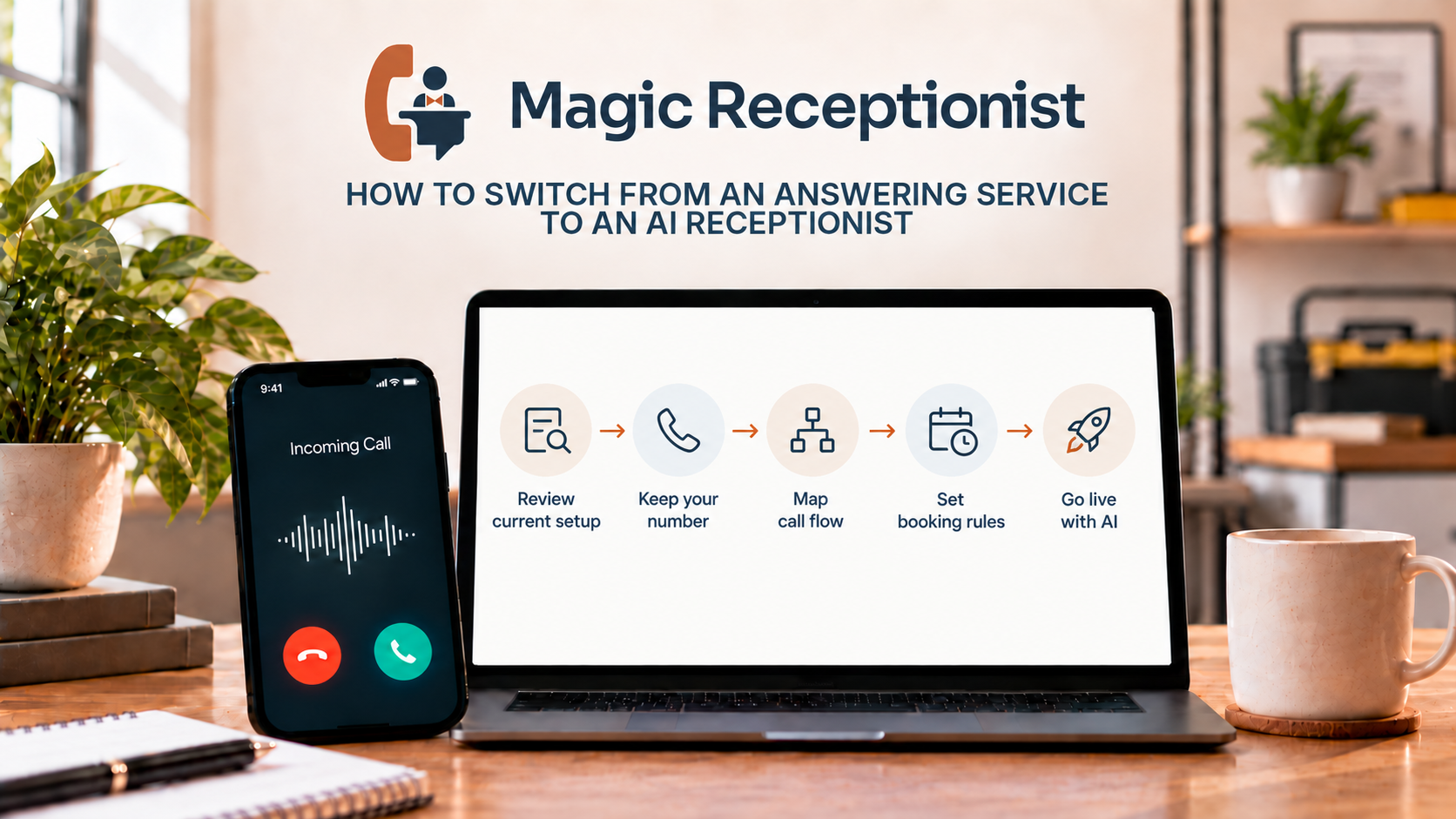
Switching from an answering service to an AI receptionist should be treated as a controlled phone-workflow change, not a same-day software toggle.
The safest approach is to document what the current service does, decide what the new receptionist is allowed to handle, configure and test the replacement workflow, verify the phone-routing steps, and move live traffic only after the new path passes realistic calls.
That process matters because an answering service may be doing more than simply picking up the phone. It may use specific greetings, collect particular fields, call an on-call person, follow special after-hours rules, or handle exceptions your team no longer thinks about because the process is familiar.
Step 1: inventory what happens today
Start with the current answering-service workflow.
Write down the main reasons people call and what the service does for each one. Capture business hours, after-hours behavior, greetings, intake questions, escalation contacts, special customer instructions, and any situations that are supposed to reach a person immediately.
Also review what your team receives after a call. Is it an email, text, portal record, call summary, or another handoff? Which details make that record useful?
This inventory becomes the acceptance checklist for the replacement.
Step 2: decide what the AI receptionist may handle
Do not copy every old script line without reviewing it.
Separate repeatable intake from work that requires human judgment.
Routine new inquiries may be suitable for structured intake. Complaints, sensitive situations, safety questions, unusual requests, or callers who need professional discretion may require a person.
Define those boundaries before you write the final call flow. The AI should know what it can collect and what it should escalate rather than trying to solve every situation conversationally.
Step 3: rebuild the intake around the information your team needs
A migration is a good time to remove unnecessary questions.
For each common call type, identify the minimum useful information the team needs to respond. That might include the caller's name, callback number, service location, reason for calling, or another approved field.
Then define the next step.
Should the team receive a call record? Should a configured person be notified? Should the call follow a routing rule? Is an appointment request captured for confirmation? Is a connected booking workflow actually available?
Only include actions that are part of the real configured system.
Step 4: plan the phone-number and forwarding change
This is one of the areas where generic migration advice can become misleading.
Whether you keep an existing number, forward it, port it, or use another routing method depends on the current carrier, number ownership, existing answering service, and receiving phone setup.
Verify the exact instructions for the systems involved before making the change.
Do not cancel the old service or move the number first and hope the new path works afterward. The phone-routing step should be part of a written cutover plan with a recovery option.
Step 5: test the new receptionist before production traffic
Run more than one happy-path call.
Test a routine inquiry, an unclear request, an existing-customer question, an after-hours call, a wrong number, a caller who asks for a person, and a situation that should trigger escalation.
For every test, check three things:
- Did the caller get a clear interaction?
- Did the receptionist stay within its approved role?
- Did the business receive the right information or handoff afterward?
If any of those fail, fix the workflow before moving production calls.
Step 6: compare the new result with the old service
Use the inventory from Step 1.
Make sure the new setup covers the important jobs you actually depended on. If the old service contacted a specific on-call person for one class of call, that requirement cannot disappear just because the new script sounds good.
At the same time, do not preserve old complexity that no longer helps. The goal is not to recreate the answering service line for line. The goal is to preserve required outcomes and improve the first-line intake where appropriate.
Step 7: move live traffic with a recovery path
There is no universal "zero downtime" migration method.
The cutover risk depends on the carrier and routing method. Use the current provider instructions and choose a time when the team can watch the result.
Keep the recovery path clear. Know how to restore the previous routing or another safe fallback if the new configuration does not behave as expected.
If a provider change involves number porting, timing and reversibility can differ from a simple forwarding change. Treat those as different operations.
Step 8: review early live calls
Testing before launch is necessary, but real callers will expose patterns you did not anticipate.
Review the first set of live calls for unclear questions, missing fields, unnecessary steps, routing surprises, and recurring requests that do not fit the current flow.
Adjust the workflow based on those observations.
The first production version should be stable enough to launch, but it does not need to be frozen forever.
Can I keep my existing business number?
Often there are ways to preserve a business's public number, but the exact method depends on the carrier and phone setup.
Do not assume that every number can be forwarded or ported in the same way. Verify ownership, carrier rules, forwarding options, and any porting requirements before changing production service.
Should I keep the old answering service during the transition?
There is no universal overlap period.
The right answer depends on the cutover method, business risk, and whether the old service can remain available as a fallback without interfering with the new routing.
Use acceptance criteria instead of an arbitrary number of days. The new system should pass realistic calls and the team should know how to recover before the old path is removed.
What about human backup?
Keep a defined human path for work that requires judgment or exception handling.
That can include complaints, sensitive conversations, requests outside the script, or situations where the business has decided a person must take over. The AI receptionist should support that operating model rather than erase it.
How does Magic Receptionist fit a migration?
Magic Receptionist can be configured around approved inbound call paths, intake fields, and company-defined routing or escalation. Optional booking, integrations, notifications, and other actions depend on what is configured and verified for the business.
The setup should therefore start with the existing call workflow, not a generic script.
If you are ready to replace an answering-service workflow, document the current path first, then start setup and test the replacement before changing production routing.
Bottom line
A good migration protects the phone number, the caller experience, and the business's ability to recover.
Inventory the current service, define the AI's role, build only the workflows you can verify, test realistic calls, plan the routing change carefully, and review early live traffic.
The goal is not to switch faster. It is to switch without losing the call-handling jobs your business depends on.