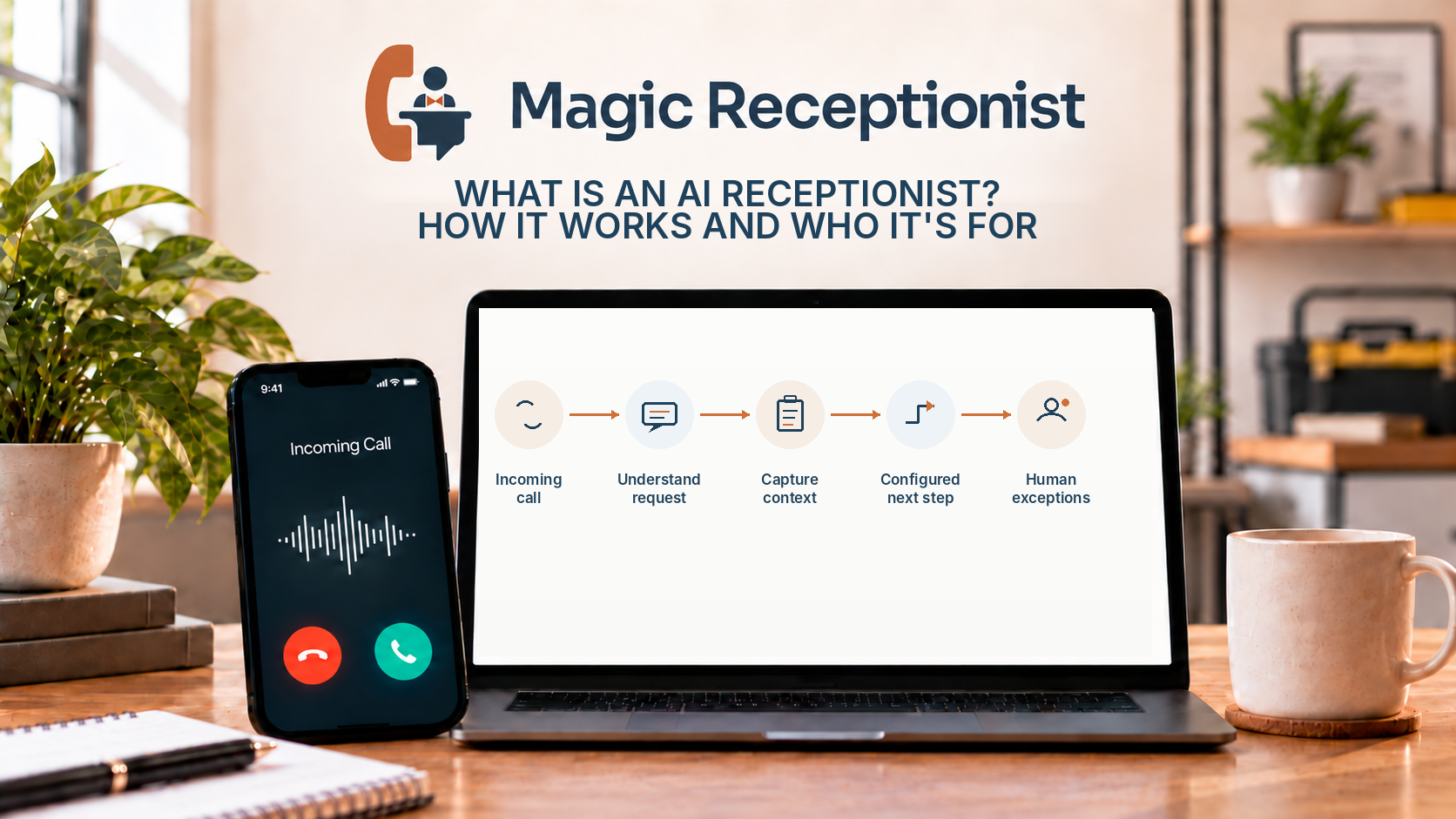
An AI receptionist is a software-based front desk for inbound calls. It can answer a configured phone line, greet callers, ask approved questions, capture useful context, and follow the next-step rules a business has set up.
For a service business, that usually means helping with the first part of a call when the owner or team is busy, away from the desk, after hours, or already speaking with someone else. The goal is not to make every decision for the business. The goal is to make the first interaction more consistent and give the team better information for what happens next.
What an AI receptionist actually does
A useful AI receptionist starts with a defined call workflow.
When a call reaches the configured line, the receptionist can use the business's greeting, identify why the person is calling, and collect the information the business has decided it needs. That may include the caller's name, callback number, service location, reason for calling, or another approved intake field.
After that, the receptionist follows the workflow that has actually been configured. Depending on the setup, that can mean creating a call record, sending a notification, routing or escalating the call, or supporting another connected action.
Those later actions are not universal. Booking, integrations, transfers, notifications, and other workflow steps depend on the plan, configuration, and connected systems. A trustworthy AI receptionist should not promise an action that has not been configured and tested.
How is that different from voicemail?
Voicemail waits for the caller to decide what to say.
That can work, but the quality of the message varies. One caller may leave a detailed explanation. Another may leave only a name and phone number. Some people hang up without leaving a message at all.
An AI receptionist can ask the same useful intake questions each time. That gives the business a more consistent record and can reduce the first round of back-and-forth when someone follows up.
For example, a home-service company may want the caller's location, service type, and urgency. A professional office may care more about the reason for the inquiry and the best way to respond. The intake should match the real business workflow instead of using one generic script for everyone.
Is an AI receptionist the same as a phone menu?
Not exactly.
A traditional phone menu or IVR usually asks callers to choose from a fixed set of options, such as "press 1 for sales" or "press 2 for support." An AI receptionist can instead use conversational intake to understand the request and collect structured information.
That does not mean the AI should improvise without limits. The business still needs clear rules for what the receptionist may ask, what it may do, and when a person should take over.
What should stay with people?
AI reception is strongest at repeatable first-line work.
People remain important for judgment, exceptions, complaints, sensitive situations, nuanced sales conversations, safety decisions, and anything that requires professional discretion. Businesses with walk-in customers also still need people for the physical front-desk experience.
A good setup makes that boundary explicit. Common intake can be handled consistently, while unusual or sensitive situations follow the business's human escalation path.
Who is an AI receptionist useful for?
It can be useful for businesses that depend on inbound calls but cannot keep a person at the phone every minute of the day.
That includes owner-led service companies, field-service teams, small offices, and businesses where staff are often helping customers away from a desk. It can also support after-hours or overflow coverage when the business wants a defined intake path outside normal staffing.
The best fit is not determined by company size alone. It depends on how important inbound calls are, how often calls go unanswered, how repeatable the first part of the conversation is, and whether the business can define clear next-step rules.
What should you decide before using one?
Start with the calls you already receive.
Write down the most common reasons people call. Identify the information your team needs before it can respond. Decide which situations can follow a standard process and which should reach a person.
Then define the boundaries:
- What should the receptionist ask?
- What information should it never request or decide?
- Which calls need a human?
- What should happen after a normal call?
- What should happen when the caller's request does not fit the script?
- How will the team review the result?
This is more useful than starting with a long script. The receptionist should be built around the business's real call flow.
What does Magic Receptionist do?
Magic Receptionist is built for service businesses that need dependable inbound-call intake and handoff when staff are busy or unavailable.
Its product family supports configured inbound call answering, approved intake fields, and the routing, notification, booking, integration, or handoff steps that are actually configured and verified. Optional actions remain conditional on the setup.
That distinction matters. A business should know exactly what its receptionist is configured to do before relying on it.
What should you test before going live?
Run realistic calls.
Test a routine new inquiry, an existing-customer question, an unclear request, an after-hours call, a wrong number, and a situation that should reach a person. Check both sides of the experience: what the caller hears and what the team receives afterward.
If the receptionist asks unnecessary questions, misses important context, or handles an exception poorly, fix the workflow before sending more production calls through it.
Bottom line
An AI receptionist is best understood as a configurable first-line call-handling system, not a replacement for every front-desk task.
It can make inbound call coverage more consistent, capture useful caller context, and follow defined next steps. People still own the decisions, exceptions, and relationship-heavy work that require judgment.
If you want to see how that kind of coverage fits a real service-business call flow, continue with our article on after-hours and overflow call coverage.