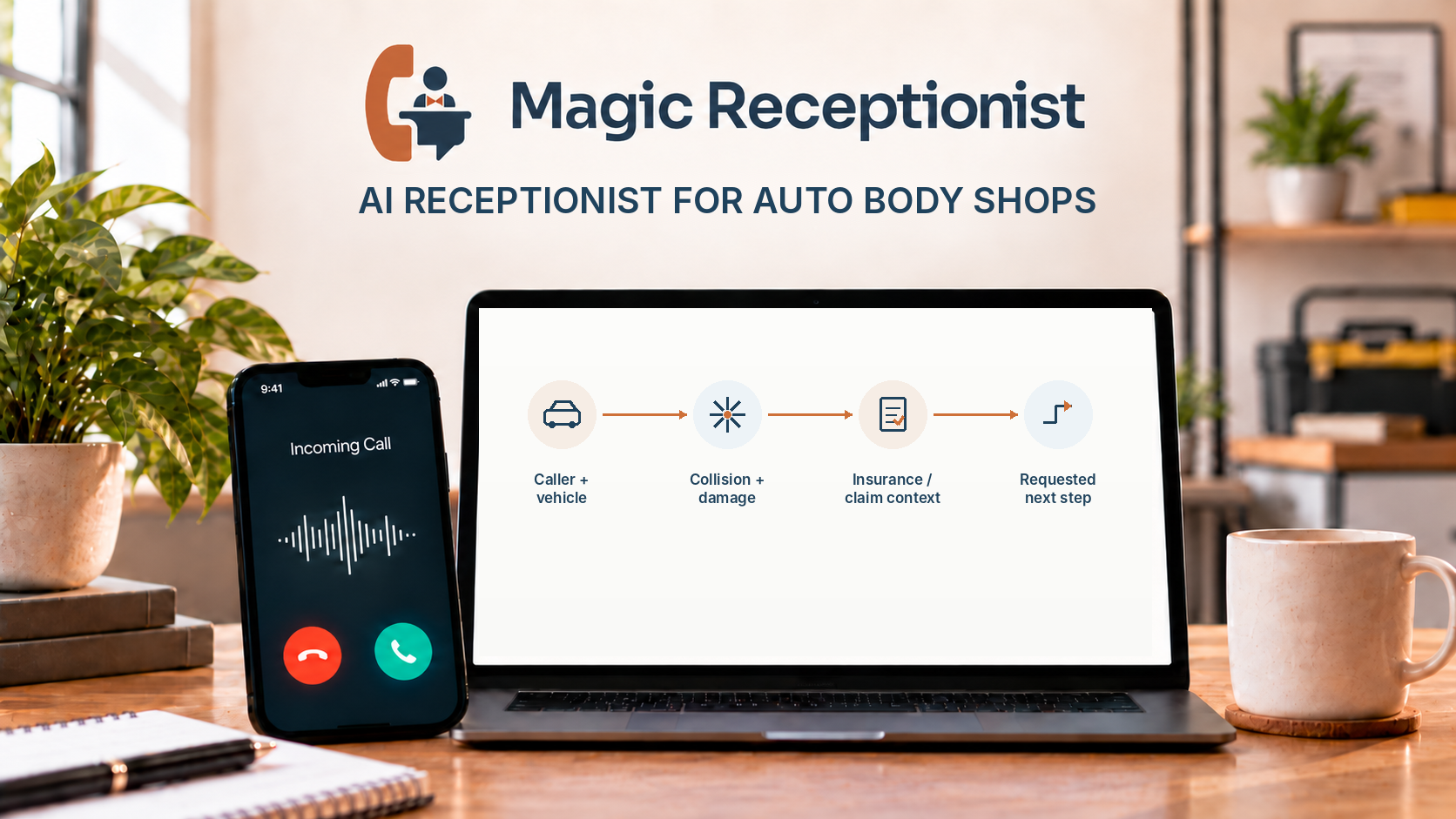
A collision-shop phone line handles new estimate requests, insurance questions, tow-related calls, existing-repair updates, vendor calls, and customers who do not know what to do after an accident. Useful intake identifies the call and gives the estimator or front office the context needed for follow-up.
An AI receptionist can be useful in an auto body shop when its job is intake: answer the call, capture who is calling, collect the basic vehicle and collision details the shop has approved, and record what the customer wants to do next. It should not write the repair estimate, decide whether a vehicle is safe to drive, promise what insurance will cover, or invent a completion date for a repair already in progress.
What an AI receptionist can handle for an auto body shop
A useful first-layer intake can collect:
- Caller name and callback number
- Vehicle year, make, and model when the caller knows it
- What happened, in the caller's own words
- Where the visible damage is located
- Whether the caller says the vehicle is drivable
- Whether insurance is involved
- Carrier, claim number, or adjuster details the caller already has
- Whether the caller wants an estimate, a callback, a visit, towing information, or an update on an existing repair
That gives the estimator or front office a better starting point than a voicemail with no vehicle, claim, or damage context.
Estimate requests: collect facts, do not estimate by phone
An AI receptionist can gather the information an estimator will want before calling the customer back. It should not turn a caller's description into a repair price or repair plan.
Collision repair can involve information that is not obvious from a phone conversation or a few exterior photos. I-CAR's Repairability Technical Support resources are built around OEM repair procedures, diagnostics, calibrations, parts and vehicle-specific repair requirements. That is a useful reminder that the actual repair decision belongs with the shop's qualified estimating and repair process.
A better phone outcome is: the shop knows which vehicle is involved, what the caller can see, whether insurance is involved, and what next step the customer is requesting.
Can the AI collect damage photos?
Yes, but only when the shop has a photo workflow that is actually configured.
Magic Receptionist's current auto-body setup treats photo intake as an optional downstream workflow, not a capability that should be assumed for every shop. If a photo-upload or messaging path has been configured and tested, the receptionist can direct the customer to it. If not, it can simply record that the customer has photos and let staff decide how they want to receive them.
Photos can help a shop prepare for the next conversation. They should not be presented as a substitute for whatever inspection, measuring, scanning, teardown, or estimating process the repair actually requires.
What about insurance questions?
The receptionist can collect the insurance information the customer already has. It should not promise that a repair, rental, tow, deductible, part, or other expense is covered.
The National Association of Insurance Commissioners' auto-insurance guidance explains that coverages vary and that items such as towing, rental reimbursement, collision, and comprehensive coverage depend on the policy. The customer and insurer are the right sources for policy-specific coverage decisions.
For the shop, the useful intake is straightforward: record the carrier, claim number, adjuster information if available, and the customer's question. Staff can then handle the claim-specific conversation using the shop's normal process.
Drivability and towing calls
A receptionist can ask whether the caller says the vehicle is drivable and whether they are asking for towing help. It should not tell the customer that a damaged vehicle is safe to drive.
If the shop has an approved towing relationship or towing instructions, those can be built into the call flow. If not, the receptionist should capture the request for staff rather than inventing a tow provider, price, arrival time, or insurance promise.
That keeps the customer moving without turning an intake system into a roadside-safety decision maker.
Existing repair and status calls
Existing customers may call about repair status, supplements, parts, pickup timing, rental coordination, documentation, or another question tied to an active repair.
The AI can identify the caller, capture the repair reference the shop uses, and record the question. Current repair status and completion dates should come from the shop's actual management system or staff. If that system is not connected and verified, the receptionist should not guess from a generic script.
After-hours and overflow calls
Auto body calls do not stop when the estimator is with a customer or the front office closes. A shop can use an AI receptionist for the call paths and coverage windows it chooses, including overflow or after-hours intake.
The important part is not simply answering. It is giving each caller a clear next step. A new collision estimate, an existing repair, a tow request, and an insurance question should not all end in the same generic message.
How Magic Receptionist fits an auto body shop
Magic Receptionist for auto body shops can collect approved caller, vehicle, damage, carrier, and drivability context and record whether the caller is requesting an estimate, callback, or another configured next step.
Exact routing, notifications, photo workflows, booking actions, CRM or management-system connections, and other downstream actions depend on the plan and workflow the shop has actually configured. The core job is controlled inbound intake, not replacing the estimator or collision-repair system.
What a shop should decide before launch
Which calls should the AI handle?
Choose the main line, overflow, after-hours calls, or another defined path. Start with the calls that are repetitive enough to script clearly.
What information does the estimator actually need?
Build the intake around the fields your team uses. Do not collect extra information just because the system can ask another question.
How should estimate requests end?
Decide whether the next step is a callback, an appointment request, a configured booking action, or another shop-approved process. Make it clear whether a requested time is actually confirmed.
How are photos handled?
Use a photo path only if it exists and has been tested. Otherwise capture the fact that photos are available and let the shop choose the next step.
What is the towing path?
Use the shop's approved towing instructions or capture the request for staff. Do not make safety or coverage promises from the phone script.
Which calls require a person?
Repair strategy, estimate disputes, insurer negotiations, safety questions, unusual vehicle requirements, and commitments about price or completion timing should have a clear human path.
Bottom line
An AI receptionist can make an auto body shop easier to reach by handling the predictable first layer of collision intake. The value is not having AI pretend to be an estimator. It is giving the shop a cleaner record of who called, what vehicle is involved, what the customer says happened, what claim information they already have, and what they need next.
When the boundaries are clear, the customer gets a useful response and the estimator starts the follow-up with more context instead of a vague voicemail.