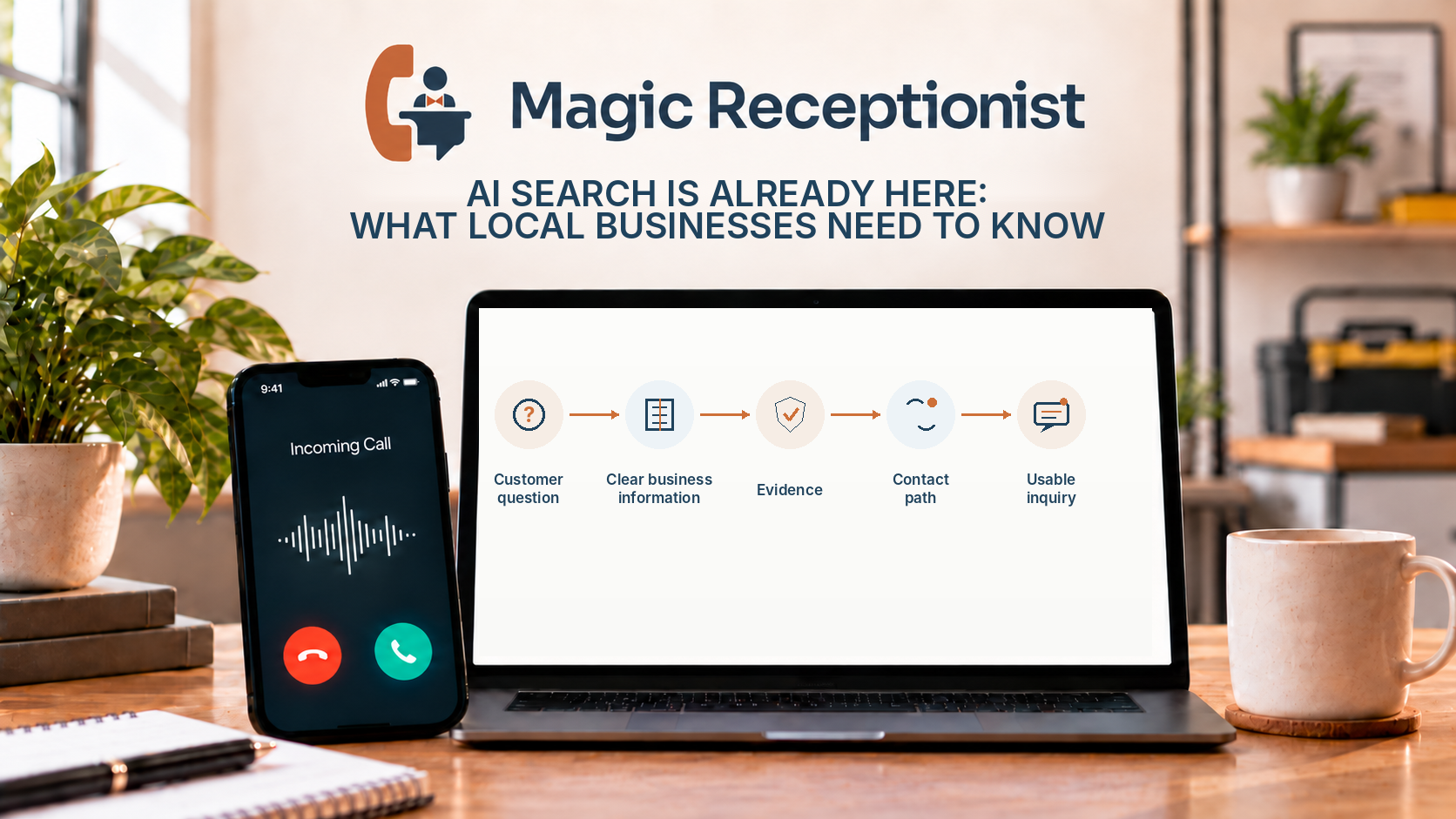
AI Search is already part of how people find information, compare options, and decide what to do next. For a local service business, the practical job is not to chase an AI-ranking trick. It is to make the business easy to discover, understand, verify, and contact. Then make sure the inquiry is actually captured when the customer reaches out.
AI Search is already mainstream
Pew Research Center surveyed 5,119 U.S. adults from February 17–23, 2026.
- 42% said they ever use AI chatbots to search for information.
- 60% said they ever read AI summaries at the top of search engine results.
Those numbers do not mean traditional search disappeared. They mean the discovery journey now includes generated answers and summaries alongside ordinary search results.
What does “AI Search” mean?
AI Search is a useful umbrella term for search experiences that generate or summarize answers instead of only presenting a list of links. Examples include ChatGPT, Google AI Overviews and AI Mode, Perplexity, Gemini, and Copilot.
The systems are not identical. Their retrieval, ranking, citation, and data-access methods differ. That is why a local business should avoid one-size-fits-all promises about “ranking in AI.”
For Google specifically, current Search Central guidance says normal SEO best practices remain relevant and foundational for generative AI features such as AI Overviews and AI Mode. Google emphasizes useful, unique, non-commodity content and pages that Search can crawl and index rather than a separate collection of AI-only tricks.
A simple local-business example
Suppose a homeowner asks an AI search tool, “Who can fix a leaking water heater tonight?” A plumbing company is easier to understand when its site clearly states the area it serves, when emergency calls are answered, the types of work it handles, and how to contact the team.
That clarity helps a person decide whether to call and gives search systems clearer information to work with. If the homeowner does call, discovery is only the first half of the job. The business still needs a dependable way to answer, capture the address and problem, and get the request to the right person.
Why should a local service business care?
A service business can lose an opportunity at three different points.
- Be understood. Services, locations, expertise, policies, and contact paths need to be clear enough for customers and discovery systems to understand what the business actually does.
- Be trusted. Important claims are easier to evaluate when they are supported by current facts, examples, reviews, policies, named processes, or credible sources instead of generic marketing language.
- Capture the opportunity. A prospect can find the business and still be lost if the call reaches voicemail or the handoff breaks while the owner, technician, dispatcher, or front desk is busy.
Clear information and supporting evidence address the first two. A dependable intake and response process addresses the third.
Four practical priorities
- Answer real customer questions directly. Start with questions customers ask before buying. Put the direct answer near the beginning, then add the scope, exceptions, evidence, options, and next step that make the answer useful.
- Publish evidence instead of empty claims. Use current statistics, first-party examples, reviews, policies, screenshots, case studies, and named methods where they actually support the point. Avoid guarantees the evidence does not support.
- Keep your business information consistent. The company name, services, locations, contact information, and positioning should agree across the website and the public profiles customers rely on.
- Connect discovery to a dependable next step. A useful article, search result, or AI recommendation creates an opportunity, not a customer. Make sure the person can contact the business and that the inquiry reaches a usable next step.
If phone calls are an important part of that next step, Magic Receptionist can answer the inbound calls it is set up to handle, capture what the caller needs, and leave the team a usable callback record. Booking, transfers, texts, and integrations are only available when they are part of the business’s setup.
What should a business do first?
Pick one high-value question prospects repeatedly ask and create the clearest, best-supported answer you can. Make sure the page can be crawled and indexed, gives the reader a working next action, and connects to a contact path the business can actually handle.
Then measure the whole path: whether people find the page, where they came from, whether they engage with it, and whether they call, submit a form, or become a qualified inquiry. The point is to understand the path from being found to receiving a real customer opportunity, not search visibility by itself.
Bottom line
AI Search is not a replacement for SEO. It is a broader discovery environment built on many of the same fundamentals: clear information, technical access, genuine expertise, evidence, reputation, and a useful customer experience.
The point is not to repeat “AI optimized.” It is to publish useful, verifiable answers and reliably handle the inquiry when the right customer arrives.